Loading

How it works
How Antic's numbers work
What each number means, what goes into it, how fresh it is and what it can't tell you. We keep the exact recipes private; this page tells you enough to read every number.
Three rules behind every number
Estimates are labelled
A fair price, an EV and a win chance are estimates from market data. Antic keeps them apart from the prices a book actually offers.
Every price has an age
Each price shows when the book last sent it. A book that has gone quiet is flagged, and Antic stops using its prices for edges.
Nothing is invented
When a number can't be worked out from real data, Antic leaves it blank and says why. It never fills the gap with a guess.
On this page
Reading a price
The building blocks every other number uses. These are textbook definitions, the same at every book.
Odds and implied chance
Every price can be turned into the chance it implies. A price of +150 implies a 40% chance; -110 implies about 52.4%. Antic shows odds in American format and converts them the same way everywhere.
- Positive American odds (+150)
- 100 ÷ (odds + 100)
- Negative American odds (-110)
- |odds| ÷ (|odds| + 100)
- Decimal odds
- 1 ÷ decimal odds
What goes in
- The price a book shows for one side of one market.
- Nothing else: this is pure arithmetic.
How fresh it is
As fresh as the price itself. Each price in Antic carries the time the book last sent it.
What it can't tell you
An implied chance includes the book's margin, so it overstates the real chance. It says what the price charges, not what will happen.
Where you see it
The books' margin (hold)
Add up the implied chances of every side of a market and you get more than 100%. The extra is the book's margin, also called the vig or hold. Both sides at -110 add up to about 104.8%, a margin of about 4.8%.
- Margin of one market
- sum of every side's implied chance − 100%
What goes in
- The prices for every side of the same market at the same book (or the best price on each side, across books, for low hold).
How fresh it is
Worked out from the same prices, so it is exactly as old as the oldest of them.
What it can't tell you
A low margin makes a market cheaper to bet, not more likely to win. Margin says nothing about which side is the better bet.
Where you see it
Fair price (fair chance)
Antic's estimate of each side's true chance, with the margin taken out. It is the yardstick the Edge tools measure every other price against. Each fair price is shown with a confidence level.
What goes in
- Prices from several of the most efficient sportsbooks and exchanges, chosen separately for each kind of market: game lines, player props, alternate lines and futures.
- Each source's margin is removed before the sources are combined.
- An exchange counts for more when real money is posted at its price.
- Members can pick their own books for the fair price in the app's settings.
How fresh it is
A source whose price has gone stale is left out. If too few current sources remain, Antic shows no fair price rather than a weak one. A book is never measured against its own price.
What it can't tell you
A fair price is an estimate of the chance, not a price you can bet. Markets can be wrong, and estimates for thin markets (some props and futures) carry less confidence.
Where you see it
Finding an edge
The Pro tools compare live prices with each other and with the fair price.
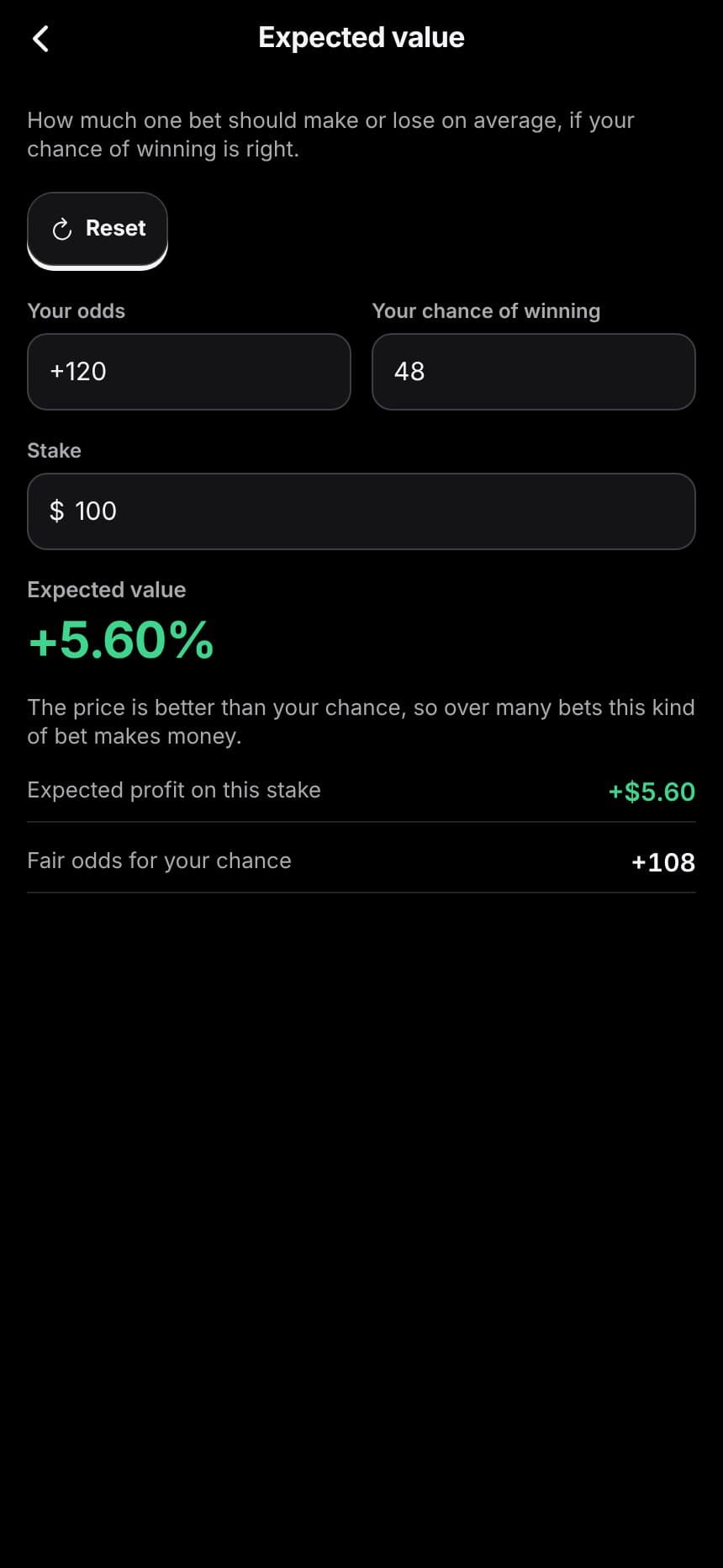
EV % (expected value)
How much more a price pays than the fair chance says it should, per dollar staked, over the long run. +3% EV means that, on average, each $100 staked returns $3 more than it costs.
- Expected value of a bet
- fair chance × decimal odds − 1
What goes in
- The book's price on one side.
- The fair chance for that side, from sources other than that book.
How fresh it is
Rows are rebuilt as prices arrive and show their age. A row only appears when the edge clears a minimum; an edge that looks too large to be real is treated as a stale or mismatched price and kept off the list.
What it can't tell you
EV is a long-run average. Any single bet can lose, and losing streaks happen at good prices. The edge is only as good as the fair price behind it, and books can move or limit a price before you bet.
Where you see it
Arbitrage
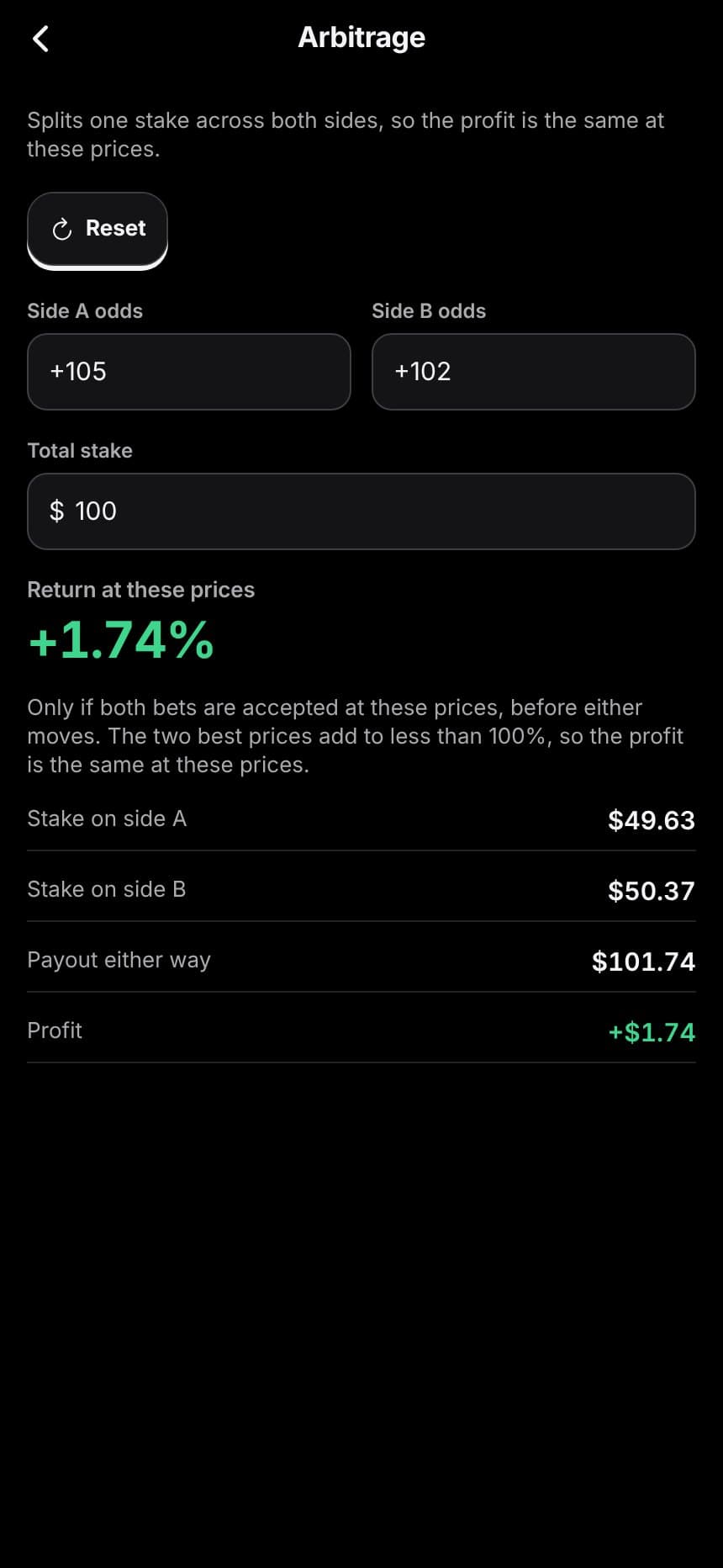
When two or more books disagree enough, betting every side at the best prices locks in a profit whatever happens. Antic splits the stakes so every result pays the same.
- An arbitrage exists when
- sum of the best implied chance on each side < 100%
What goes in
- The best price on each side of the same market, at different books.
- The profit %, the stake on each leg and the largest total stake the reported limits allow.
- Limits only where a book reports them; blank when unknown.
How fresh it is
Each leg shows its own age. Antic checks the price again before it opens a book.
What it can't tell you
The profit holds only if every leg is placed at those prices. Prices move, books limit accounts and some books void bets they see as mistakes.
Where you see it
Middles
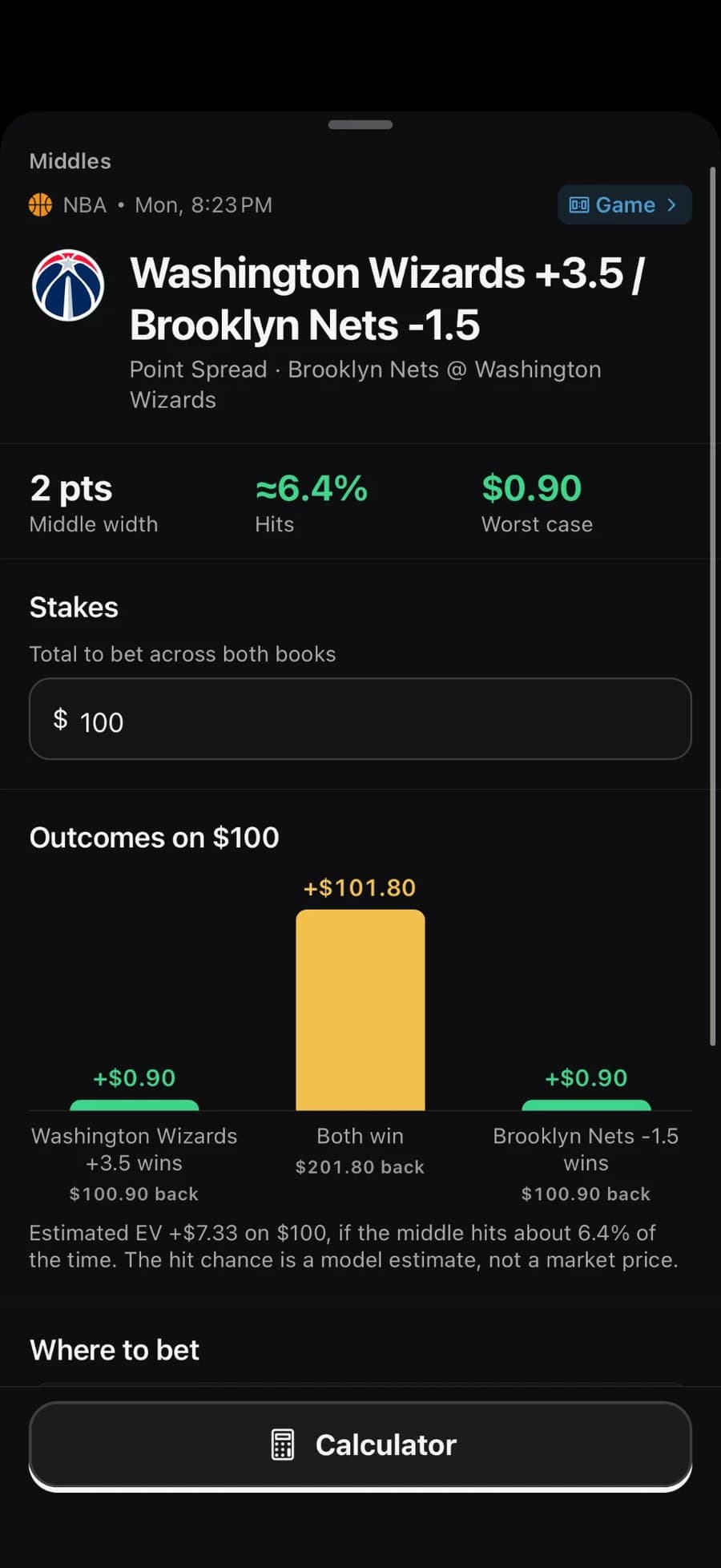
Two bets on opposite sides at different numbers, with a gap between them. If the result lands in the gap, both bets win; otherwise one wins and the other loses, usually for a small net cost.
What goes in
- The two lines and their prices, at different books.
- The worst-case result, the payout if both win, and a chance of landing in the gap estimated from the market.
How fresh it is
Both legs show their age, and the prices are checked again before a book opens.
What it can't tell you
Most middles miss. The chance of hitting the gap is an estimate, and a miss still costs a little.
Where you see it
Low hold
The margin left when you combine the best price on each side across books. A market with almost no hold is the cheapest place to bet both sides, which is useful for clearing promos and rollover.
What goes in
- The best current price on each side, across the books you can use.
How fresh it is
Rebuilt as prices arrive; each side shows its age.
What it can't tell you
Low hold means low cost, not profit. Betting both sides of a low-hold market still loses the small margin that remains.
Where you see it
Fantasy optimizer
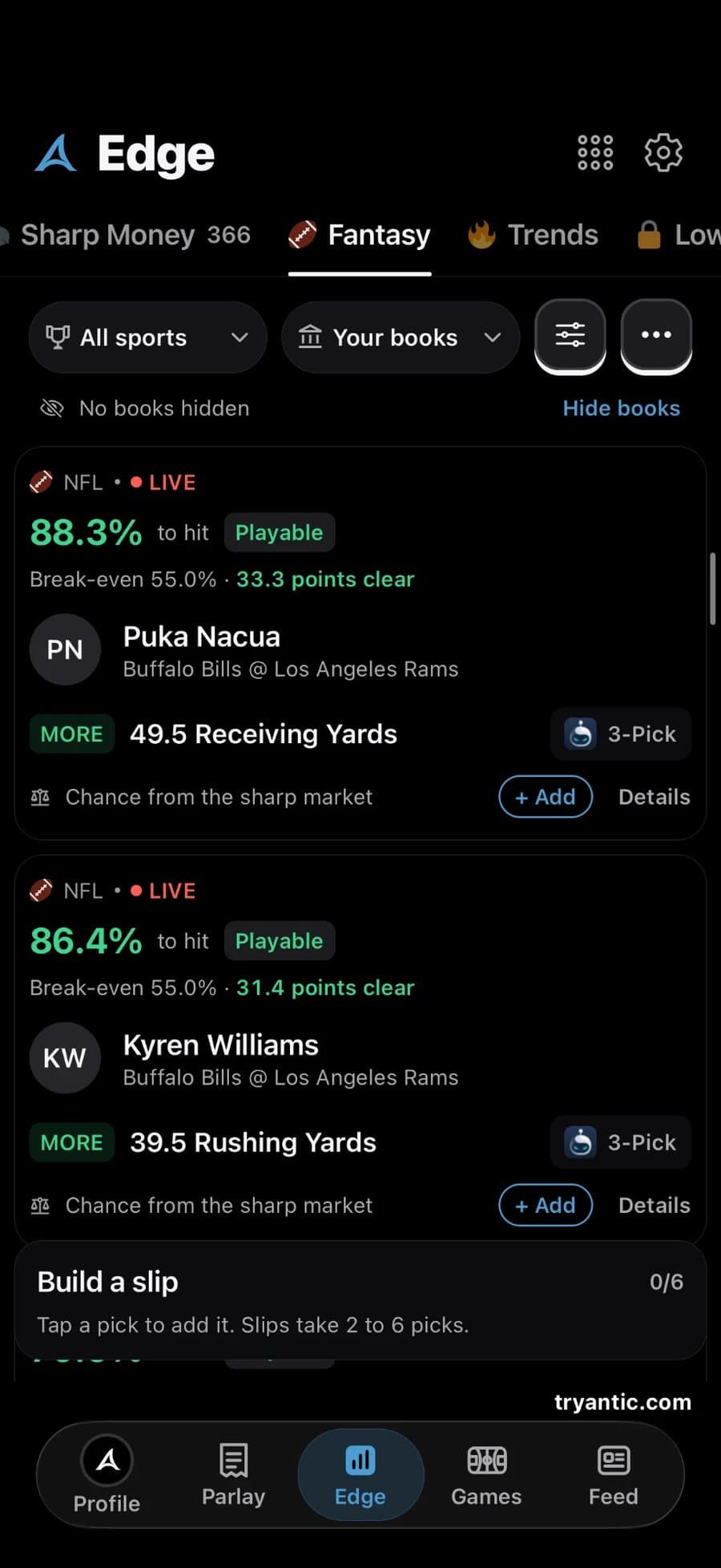
For pick'em apps, the chance each pick hits, using the same player line priced at sportsbooks with the margin removed, compared with the hit rate an entry needs to break even.
What goes in
- The pick'em app's line for a player.
- Sportsbook prices for the same player, stat and line.
- The break-even rate for the entry type you choose.
How fresh it is
As fresh as the sportsbook prices behind it, each shown with its age.
What it can't tell you
A pick only shows when sportsbooks price the same line. A high hit chance on each pick does not make an entry a sure thing; entries need every pick (or most picks) to hit.
Where you see it
Parlays
An estimated EV for a parlay, built from each leg's fair chance, and the best price for the whole parlay at each book.
- Parlay odds (independent legs)
- decimal odds of leg 1 × leg 2 × …
What goes in
- Each leg's fair chance.
- Each book's parlay price, where the book offers it.
How fresh it is
Each leg's price shows its age; the parlay is priced from the current legs.
What it can't tell you
Legs from the same game can be related, and books price same-game parlays their own way. Treat a parlay's EV as rougher than a single bet's, and expect most parlays to lose.
Where you see it
Context for a pick
Numbers that describe a player, a game or your own record. None of them is a forecast on its own.
Trends
How often a player cleared today's line: over the last 5 games, the last 10, the season and against today's opponent.
What goes in
- The player's finished games and box scores.
- Today's line for the stat. Pushes are left out of the count.
How fresh it is
Updated after games finish and box scores are final.
What it can't tell you
A streak is not a probability. Past games don't account for injuries, minutes, matchups or a line that has already moved.
Where you see it
Stake sizing (Kelly)
A suggested stake as a share of your bankroll, sized to the edge: a bigger edge suggests a bigger share. Antic never suggests more than the caps you set in Settings.
- Full Kelly share of bankroll
- (decimal odds × fair chance − 1) ÷ (decimal odds − 1)
What goes in
- The price and its fair chance.
- Your bankroll, the fraction of Kelly you choose and your bet-size cap.
How fresh it is
Recalculated whenever the price or fair chance changes.
What it can't tell you
Kelly assumes the fair chance is right. Because it is an estimate, most bettors stake a fraction of Kelly. It is a sizing aid, not advice to bet.
Where you see it
Bet tracker
Your own record from the bets you log: profit, wins, losses and pushes, ROI, money at risk and closing-line value.
- ROI
- profit ÷ total staked on settled bets
- Closing-line value
- how your price compares with the last price before the game started
What goes in
- Only the bets you enter. Antic never sees your sportsbook account.
How fresh it is
Updates when a bet settles or you edit it.
What it can't tell you
Short samples swing a lot. A few hundred bets say more than a few dozen, and a good record over a short run can be luck.
Where you see it
Win probability (game rooms)
Each team's chance of winning, read from the live market price with the margin removed. It moves with each play as the prices move.
What goes in
- Live moneyline prices during the game.
- The game state the feed reports (score and clock).
How fresh it is
As fresh as the live prices. Books pause live markets during big moments, so it can lag a play by a little.
What it can't tell you
It is the market's view of the game as it stands, not a prediction by Antic and not a pick.
Where you see it
Antic Rating and game rating
The Antic Rating scores one player's game from 0 to 10: their box score and how much their plays moved the team's chance of winning. The game rating uses the same scale for how exciting a game was: how far the win chance swung, how often the lead changed and how close it stayed late.
What goes in
- The box score and play-by-play from the data feed, where the league provides them.
- The win chance after each play. In sports without a play-by-play win chance, the rating comes from the box score alone.
How fresh it is
Updated after each play while a game is live, and settled once the box score is final.
What it can't tell you
A rating describes what has happened. It is not a prediction, not a pick and not a grade of a person. When the data needed for a rating is missing, no rating is shown.
Where you see it
Keeping numbers honest
How Antic keeps an old or partial number from passing as a live one.
Freshness, limits and the recheck
Every price shows its age. Limits are what a book reports, and blank when it doesn't. When you tap a book, Antic checks the price again before opening it.
What goes in
- The time each book last sent each price, from the odds feed.
- Maximum stakes and posted money, only where a book or exchange reports them.
How fresh it is
The feed status page shows, league by league, when each book last sent prices. A stalled book is flagged there and on every screen that uses it.
What it can't tell you
Opening a book is not a bet. The book can still change or pull a price after you arrive, so always check it there before you bet.
Where you see it
What we keep private, and why
The exact recipes behind a fair price stay private: which sources count for which markets, how much each one counts and the cut-offs that decide when a price is too old or too thin to use. Everything you need to read a number is on this page, and each estimate in the app is labelled as one.
Keep reading
- GlossaryEvery term, with a worked example.
- Free calculatorsEV, no-vig fair odds, arbitrage, middles, hold, parlays and Kelly.
- How we rateWhat the Antic Rating and the game rating measure.
- Product docsHow every tool and screen works.
- Feed statusWhen each book last sent prices.
- FAQAccounts, billing, data and responsible play.
See every number on live prices.
Antic Pro runs these numbers on live prices from every book we compare. 7 days free, cancel any time before the trial ends.
Antic is 18+. Betting is 21+ in most states. Gambling problem? Call 1-800-GAMBLER. Antic never places bets; opening a book is not a bet.